Who Wrote Them? Composed by anonymous ancient sages of what became Hinduism; passed along as oral teachings until reaching their final printed form.
What Are They? Hindu holy books, along with The Vedas and The Bhagavad Gita; “Spiritual treatises”, in the words of Juan Mascaró; written in Sanskrit, the language of ancient conquerors of India, a language which shares a common Indo-European root with Greek, Latin, German, English, etc; teachings, passed down via oral tradition until being written down; there are 112 Upanishads, according to Mascaró.
When Were They Written? Between 800 and 400 BC
Where Were They Written? India.
Why Were They Written? To guide seekers to liberation.
Further facts:
1. These treatises were not intended for “mass consumption”. Those who initially spoke them believed that only a few highly- motivated persons were able to understand them.
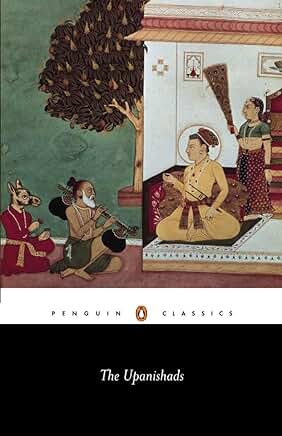
2. Sanskrit Etymology of Upanishad, according to Mascaró: verb: sad – to sit; prefix: upa (related to Latin sub) – under; prefix: ni (as in English “beneath”) A Upanishad is a lesson learned sitting at the feet of a teacher.
(Compare to the beginning of Jesus’ Sermon on the Mount: Matthew 5:1-2 “But seeing the crowds, he went up onto a mountain. And when he had sat down, his disciples came near him. And opening his mouth, he began teaching them.”)
Key Quotes from the Book:
from the Introduction
“...the visions of the Upanishads are based on a consciousness of our own being in relation to the Being of the universe . . .” pg 15
“Each of us is a centre of life, a unique event in the universe...” pg. 15
from the Kena Upanishad
“Who sends the mind to wander afar? Who first drives life to start on its journey?” pg. 51
from the Katha Upanishad
(The story of Nachiketas’ dialogue
with Yama, the god of Death.)
“What lies beyond life shines not to those who are childish, or careless, or deluded by wealth. ‘This is the only world. There is no other’, they say; and thus they go from death to death.” pg. 58
“If the slayer thinks that he kills, and if the slain thinks that he dies, neither knows the ways of truth. The Eternal in man cannot kill. The Eternal in man cannot die.” pg. 59
“Awake, arise! Strive for the Highest, and be in the Light! Sages say the path is narrow and difficult to tread, narrow as the edge of a razor.” pg. 61
(Compare to Matthew 7:13-14: “Enter ye in at the strait gate: for wide is the gate, and broad is the way, that leadeth to destruction, and many there be which go in thereat: 14 Because strait is the gate, and narrow is the way, which leadeth unto life, and few there be that find it.”)
“The Creator made the senses outward-going: they go to the world of matter outside, not to the Spirit within... The foolish run after outward pleasures and fall into the snares of vast-embracing death. But the wise have found immortality, and do not seek the Eternal in things that pass away.” pgs 61-62
“If one sees him in this life before the body passes away, one is free from bondage; but if not, one is born and dies again in new worlds and new creations.” pg. 65
from the Prasna Upanishad
(Prasna, in Sanskrit, means “life-force”) “When that fire of life is gone, senses are absorbed in mind, and man comes to life again. His last thoughts lead him to Prana and, accompanied by the living fire of Udana and led by Atman, the Spirit himself, he goes to the regions deserved and desired in his imagination... He who knows the rising of life and how it comes to the body, how it abides there in its five-fold division, and knows its relation to the inner Spirit, enjoys eternal life,
in truth enjoys eternal life.” pg. 71
(Prana – breath; Udana – awareness; Atman – divinity)
“Even as birds, O beloved, return to their trees for rest, thus all things find their rest in Atman, the Supreme Spirit.” pg. 72
“...who speaks untruth withers like a tree to the roots; I will not speak untruth.” pg. 74
from the Mundaka Upanishad
“Abiding in the midst of ignorance, but thinking themselves wise and learned, fools aimlessly go hither and thither, like blind led by the blind. Wandering in the paths of unwisdom, ‘We have attained the end of life’, think the foolish. Clouds of passion conceal to them the beyond, and sad is their fall when the reward of their pious actions has been enjoyed.” pg. 77
“This is the truth: as from a fire aflame thousands of sparks come forth, even so from the Creator an infinity of beings have life, and to him return again.” pg. 77
“There are two birds, sweet friends, who dwell on the self-same tree. The one eats the fruits thereof, and the other looks on in silence.” pg. 80
“The wise who, free from desires, adore the Spirit pass beyond the seed of life in death.” pg. 81
“As rivers flowing into the ocean find their final peace and their name and form disappear, even so the wise become free from name and form and enter into the radiance of the Supreme Spirit who is greater than all greatness... In truth who knows God becomes God.” pg. 81

from the Svetasvatara Upanishad
“In this vast Wheel of creation where all things live and die, wanders round the human soul like a swan in restless flying, and she thinks that God is afar. But when the love of God comes down upon her, then she finds her own immortal life.” pg. 86
“When a man knows God he is free: his sorrows have an end, and birth and death are no more.” pg. 86
“Know that Brahman is for ever in thee, and nothing higher is there to be known.” pg. 86
“Even as a mirror of gold, covered by dust, when cleaned well shines again in full splendor, when a man has seen the truth of the Spirit he is one with him, the aim of his life is fulfilled and he is ever beyond sorrow.” pg. 88
“There is one in whose hands is the net of Maya, who rules with his power, who rules all the worlds with his power. He is the same at the time of creation and at the time of dissolution. Those who know him attain immortality.” pg. 89
“All this universe is in the glory of God.” pg. 90
“He knows all but no one knows him, the Spirit before the beginning, the Spirit Supreme everlasting.” pg. 90
“There is the never-born soul of man bound by the pleasures of nature; and there is the Spirit of man, never-born, who has left pleasures behind in the joy of the Beyond.” pg. 91
“When a man is bound by the three powers of nature, he works for a selfish reward and in time he has his reward... and wanders on through life and death.” pg. 94
(The “three powers of nature” are light, fire, darkness; or, alternatively, name, form, and action)
“If ever for man it were possible to fold the tent of the sky, in that day he might be able to end his sorrow without the help of God.” pg. 96
from the Maitri Upanishad
“There is a Spirit... never-born, never-dying, everlasting, ever ONE in his own greatness.” pg. 99
“A part of Infinite Consciousness becomes our own finite consciousness . . .” pg. 99
“It is therefore by vision, by harmony, and by contemplation that Brahman is attained.” pg. 101
“Samsara, the transmigration of life, takes place in one’s own mind. Let one therefore keep the mind pure, for what a man thinks he becomes: this is a mystery of Eternity.” pg. 103
from the Kaushitaki Upanishad
“You who give liberty, make me free from my sins.” pg. 105
“Know me, for this is the best for man: to know God.” pg. 106

from the Taittiriya Upanishad
“Who denies God, denies himself. Who affirms God, affirms himself.” pg. 110
“Joy comes from God. Who could live if the joy of Brahman filled not the universe?” pg. 110
“If a man places a gulf between himself and God, this gulf will bring fear.” pg. 110
“Words and mind go to him, but reach him not and return. But he who knows the joy of Brahman, fears no more.” pg. 110
from the Chandogya Upanishad
“There is a Light that shines beyond all things on earth, beyond us all, beyond the heavens, beyond the highest, the very highest heavens. This is the Light that shines in our heart.” pg. 113
“Man in truth is made of faith. As his faith is in this life, so he becomes in the beyond: with faith and vision let him work.” pg. 114
“A man is a living sacrifice.” pg. 115
“There is a bridge between time and eternity; and this bridge is Atman, the Spirit of man... Evil or sin cannot cross that bridge, because the world of the Spirit is pure. This is why when this bridge has been crossed, the eyes of the blind can see, the wounds of the wounded are healed, and the sick man becomes whole from his sickness. To one who goes over that bridge, the night becomes like day; because in the worlds of the Spirit there is a light which is everlasting.” pg. 121
“Then Virochana went to the devils full of self-satisfaction, and gave them this teaching: ‘We ourselves are our own bodies, and those must be made happy on earth. It is our bodies that should be in glory...’ That is why when here on earth a man will not give any gifts, when a man has no faith and will not sacrifice, people say, ‘This man is a devil.’” pg. 123
“It is true that the body is mortal, that it is under the power of death; but the body is also the dwelling of Atman, the Spirit of immortal life.” pg. 125
“...if a man is ruled by his body then this man can never be free.” pg 125
from the Brihad-aranyaka Upanishad
“This universe is a trinity and this is made of name, form, and action.” pg. 127
“The source of all names is the word, for it is by the word that all names are spoken. The word is behind all names, even as Brahman is behind the word.” pg. 127
“The immortal is veiled by the real. The Spirit of life is the immortal. Name and form are the real, and by them the Spirit is veiled.” pg. 127
“Maitreyi said, ‘What should I do then with possessions that cannot give me life eternal? Give me instead your knowledge, o my lord.’” pg. 130
from The Supreme Teaching
“People see his field of pleasure, but he can never be seen.” pg. 135
“According as a man acts and walks in the path of life, so he becomes.” pg. 140
“While we are here in this life, we may reach the light of Wisdom; and if we reach it not, how deep is the darkness.” pg. 141
“...there are not many but only One. Who sees variety and not the Unity, wanders on from death to death.” pg. 141
“Let him not ponder on many words, for many words are weariness.” pg. 142


